


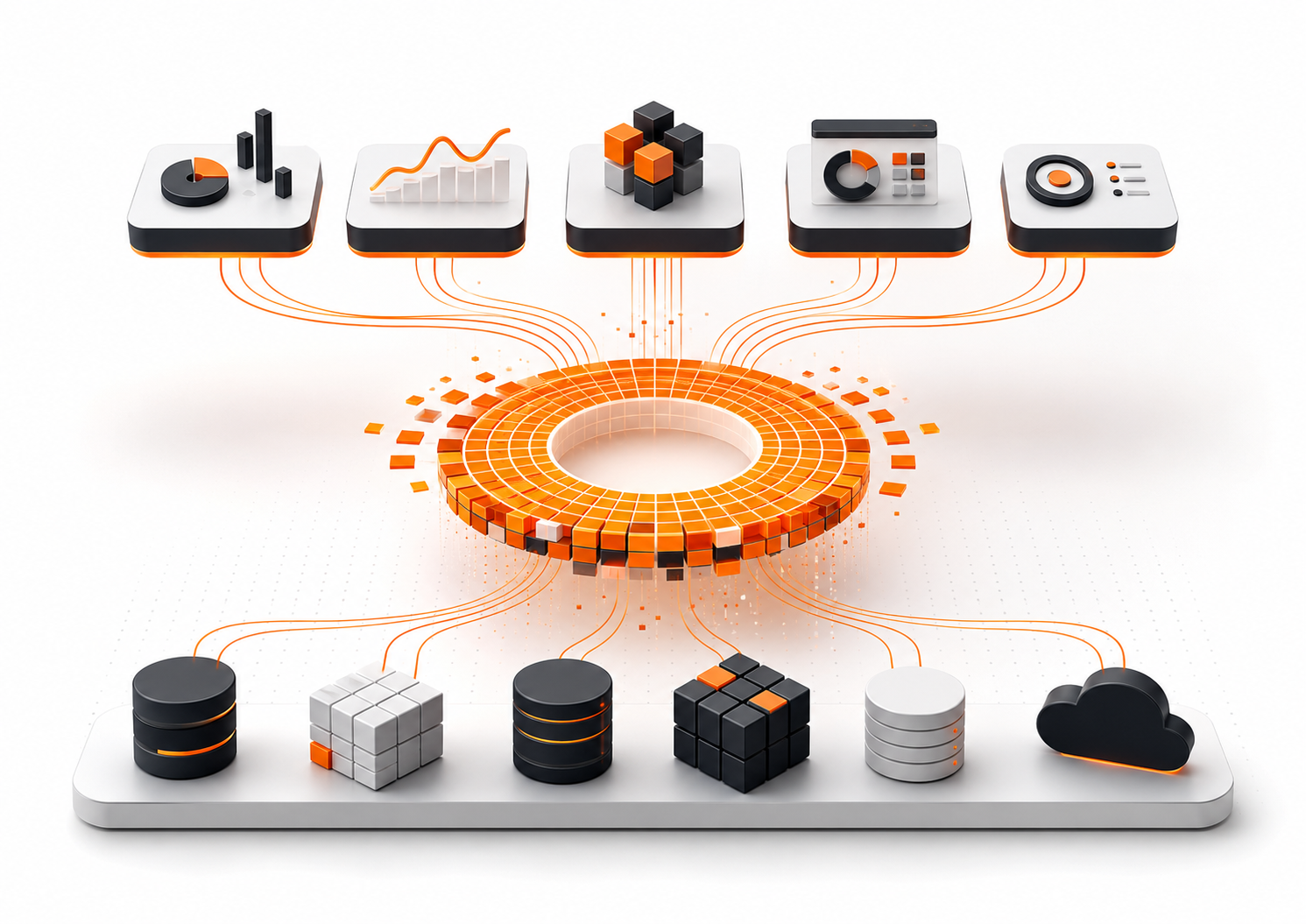
Most organizations do not have a data shortage. They have data in dashboards, spreadsheets, data warehouses, cloud platforms, CRM systems, planning tools, and many other applications. The real challenge is often not access to data, but trust in what that data means.
This is where the difference between a metrics layer and a semantic layer becomes important. Both concepts help bring more consistency to analytics. Both can reduce confusion around business numbers, but they are not the same.
A metrics layer focuses mainly on how business metrics are calculated. A semantic layer goes further. It helps define business meaning, relationships, governance, access rules, and context across the data environment.
In simple terms: a metrics layer helps make numbers consistent. A semantic layer helps make data easier to understand, use, and trust.
Why are consistent metrics not enough
Many companies know the problem well. Sales has one revenue number. Finance has another. Marketing reports customer acquisition cost in one way, while management dashboards use a slightly different definition. The result is familiar: several versions of the truth.
This usually does not happen because teams are careless. It happens because business logic grows over time. Reports are built for different needs. Definitions are copied from one dashboard to another. Formulas are adjusted in one place but not updated elsewhere.
After a while, people may have many technically correct reports, but no shared understanding of what the numbers mean. That creates a trust problem. Instead of using data to support decisions, teams spend time checking calculations, comparing dashboards, and reconciling reports.
What a metrics layer does
A metrics layer centralizes the logic behind key business metrics. Instead of letting each team calculate KPIs such as revenue, margin, churn, retention, or ARR in its own way, the organization defines these measures in one governed place. Connected tools can then use the same calculation logic.
This is valuable because it reduces duplicated work and inconsistent formulas. For example, if Monthly Recurring Revenue is defined centrally, analysts do not need to recreate the same calculation every time they build a new dashboard. If the definition changes, it can be updated in one place instead of manually across many reports.
For business users, the benefit is clear: the same KPI should mean the same thing wherever it appears. A metrics layer can help organizations standardize KPI definitions, improve reporting consistency, maintain key measures more easily, and give teams more confidence in recurring business numbers. But business meaning is not only about formulas.
Where a semantic layer goes further
A KPI does not exist in isolation. Take revenue as an example. The calculation may look simple, but the business context around it can be more complex. Is it gross revenue or net revenue? Are discounts included? Are cancelled orders excluded? Which region is the user allowed to see? Which customer hierarchy should be used? Which source system is considered authoritative? A metrics layer can define how a measure is calculated. But it may not fully manage the wider context around that measure.
A semantic layer creates a governed business layer above raw data. It defines what the data means, how different data elements relate to each other, who can access what, and how business context can be reused across tools and teams. A semantic layer can include business-friendly names for technical fields, KPI definitions, relationships between data sources, hierarchies, access rules, data lineage, and reusable business logic.
This matters because modern data environments are rarely simple. Companies often use several BI tools, planning solutions, cloud platforms, spreadsheets, and business applications. If each tool manages definitions separately, consistency becomes difficult to maintain. A semantic layer helps solve this by creating one shared place for business meaning.
The simple difference
A practical way to describe the difference is this: A metrics layer defines the formulas. A semantic layer defines the business meaning around the formulas.
A metrics layer helps answer:
- “How do we calculate this number?”
A semantic layer also helps answer:
- “What does this number mean?”
- “How does it relate to other data?”
- “Who is allowed to see it?”
- “Where did the data come from?”
- “Can this definition be reused across tools?”
This does not make the metrics layer unnecessary. Metric consistency is important. But it is only one part of the bigger picture. In enterprise analytics, trust depends not only on correct calculations, but also on shared context.
Why does this matter for enterprise analytics?
For years, many analytics projects focused mainly on reporting: faster dashboards, better visualizations, and easier access to data. These goals still matter, but expectations have changed.
Business users want answers they can trust. Analysts need to support more teams without rebuilding the same logic repeatedly. Leaders want decisions based on consistent definitions. New tools and applications need access to governed business data, not just raw tables.
In this context, trusted answers require more than centralized KPI calculations, they require shared business context that can travel across tools. Without this, organizations may still face inconsistent definitions, unclear ownership of metrics, duplicated logic, manual reconciliation, and reduced trust in reports. A semantic layer helps reduce these issues by creating one governed place where business meaning can be defined and reused.
Strategy Mosaic and the universal semantic layer approach
Strategy Mosaic supports this broader approach to enterprise data. As a universal semantic layer, it helps organizations define and govern business logic, relationships, permissions, and context in one place. These definitions can then be reused across connected analytics tools, applications, and data experiences. In practice, this supports a “define once, use consistently” approach.
Instead of rebuilding the same logic in multiple dashboards or tools, organizations can create shared business definitions that remain consistent across the data environment.
For companies already using a metrics layer, this does not necessarily mean replacing what already exists. A metrics layer can still play an important role in standardizing KPI calculations. A semantic layer can complement it by adding broader business context, governance, access control, and portability.
The key is understanding where each layer fits. A metrics layer helps teams calculate metrics consistently. A semantic layer helps the organization understand and govern data consistently.
Summary
A metrics layer is valuable because it brings consistency to KPI calculations, but enterprise data needs more than consistent formulas. It needs shared business language, governed relationships, clear access rules, reliable lineage, and reusable context that can support different tools, teams, and use cases.
That is the role of a semantic layer. The difference between “we calculate the same metrics” and “we understand data in the same way” may sound small.
FAQ
What is a metrics layer?
A metrics layer is a centralized place where organizations define the calculation logic behind business metrics and KPIs. It helps ensure that key measures are calculated consistently across tools.
What is the semantic layer?
A semantic layer is a governed business layer above raw data. It defines business terms, metric logic, relationships, permissions, and context so teams can work from the same trusted understanding.
What is the main difference between a metrics layer and a semantic layer?
The main difference is scope. A metrics layer focuses mainly on KPI calculations. A semantic layer covers a wider business context, including terminology, relationships, governance, access control, and lineage.
Does a semantic layer replace a metrics layer?
Not necessarily. A metrics layer can be part of a broader semantic layer strategy. The semantic layer adds the wider business and governance context around metric definitions.
Why does this matter for enterprise analytics?
It helps organizations reduce inconsistent definitions, duplicated logic, and manual reconciliation. More importantly, it helps teams use data with greater confidence across tools and business processes.