


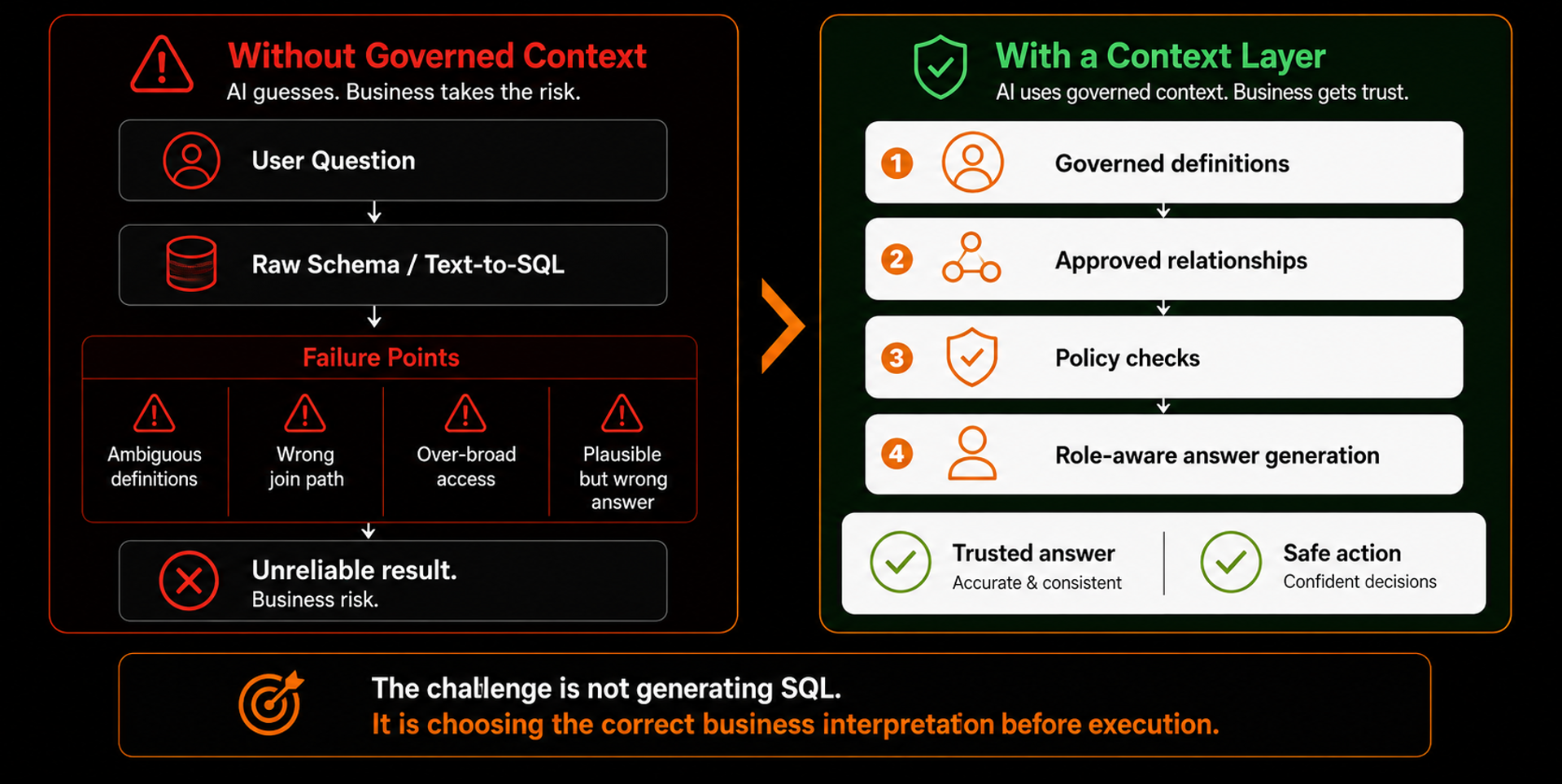
Enterprise AI does not only need more data. It needs the right business context.
A semantic layer helps provide that context by defining business terms, metrics, relationships and governance rules in a consistent, machine-readable way. This allows AI systems and AI agents to work with trusted definitions instead of guessing what terms like revenue, margin, churn or customer mean.
As AI becomes more autonomous, the semantic layer is evolving from a BI component into a foundation for trusted enterprise AI.
Why enterprise AI needs more than data access
Many organizations are experimenting with AI on top of enterprise data. At first, the results can look impressive. An AI assistant can generate a query, retrieve a number and present an answer in seconds.
But speed does not guarantee accuracy. The real challenge is not whether an AI model can generate SQL or summarize information. The challenge is whether it understands the business meaning behind the data.
For example, if someone asks about revenue, the AI needs to know more than which table contains revenue-related fields. It needs to be understood:
- which revenue definition is approved by the business,
- which source is authoritative,
- which filters or exclusions apply,
- how the metric should be aggregated,
- which users are allowed to access which data,
- and how the answer should be interpreted in a specific business context.
Without this context, the AI may produce an answer that looks correct but is based on the wrong business logic. That is where the risk begins.
The problem: AI can be technically right and business-wrong
AI systems are very good at producing plausible answers. In enterprise analytics, this can be dangerous.
A query may run successfully. The SQL may be valid. The result may look reasonable. But if the AI selected the wrong table, used the wrong join path, applied the wrong metric definition or ignored an access rule, the answer is still wrong. This is especially risky when AI agents do more than report information.
In traditional BI, a human usually reviews a dashboard, asks follow-up questions and decides what to do next. With AI agents, the system may act directly: update a CRM record, trigger a workflow, send a recommendation or support an operational decision. When AI acts on misunderstood data, the impact is no longer limited to a wrong report. It can become a wrong business action.
What is a semantic layer?
A semantic layer is a governed layer between raw data and the tools, applications and AI systems that consume it.
It translates technical data structures into business-friendly definitions. Instead of every team defining metrics separately, a semantic layer creates one consistent place for business logic.
For example, it can define:
- what “active customer” means,
- how “revenue” is calculated,
- which entities are connected,
- how hierarchies and time periods work,
- which filters should always apply,
- and who is allowed to see which data.
This makes analytics more consistent across dashboards, reports, applications and AI systems. In other words, the semantic layer helps ensure that people and systems use the same business language.
From semantic layer to context layer
For years, the semantic layer mainly supported BI and reporting. Its primary users were human analysts and business users. AI changes this.
AI agents need more than metric definitions. They need context that helps them reason safely and act within business rules.
This includes:
- business definitions,
- relationships between entities,
- approved join paths,
- user and role context,
- access policies,
- lineage from metric to source,
- auditability,
- and interfaces that AI agents can use reliably.
This is why the semantic layer is becoming context infrastructure for AI. A context layer extends the semantic layer by making business meaning, governance and decision context available to AI systems before they query, reason or act.
Why context matters for AI agents
A semantic or context layer helps reduce the amount of business meaning that AI has to infer on its own. This matters because many AI errors do not come from bad syntax. They come from missing context.
AI may not know which margin definition to use. It may not understand that two tables should not be linked in a certain way. It may apply a metric to the wrong business unit or return data that the user does not have permission to access.
A governed context layer helps prevent these issues by enforcing business logic before the query reaches the data source. This makes AI outputs more consistent, explainable and auditable.
Why this is important for enterprise AI at scale
AI pilots often start with simple use cases and clean data. In that environment, results may look promising. The real test comes later, when AI is connected to complex enterprise systems: CRM, ERP, cloud data platforms, financial systems, operational tools and multiple BI environments.
At that point, AI needs a reliable way to understand the business meaning behind all those systems. Without governed context, each AI tool may interpret data differently. This leads to inconsistent answers, limited trust and higher governance risk. With a semantic layer, organizations can define business logic once and reuse it across multiple tools, workflows and AI agents. That is a major step toward trusted AI.
The role of Strategy Mosaic
Strategy Mosaic is designed as a universal semantic layer that makes governed business definitions available across different tools, data platforms and AI environments.
Instead of locking definitions inside a single BI tool, Mosaic allows organizations to define metrics, relationships, governance rules and access policies once, then apply them consistently across dashboards, SQL, APIs and AI agents.
For enterprise AI, this is especially important. AI agents need access to trusted business definitions, not just raw schemas. By exposing governed semantics through standard interfaces such as MCP, Mosaic helps AI systems work with approved context and auditable logic.
The goal is simple: AI should not guess what the business means. It should work from governed, trusted definitions.
Summary
Enterprise AI does not become reliable simply because the model becomes more powerful. A better model can still produce faster, more confident wrong answers if the business context is missing.
The real foundation for trusted AI is governed context: consistent definitions, clear relationships, enforced access policies and auditable business logic. That is why the semantic layer is becoming much more than a BI component. It is becoming critical infrastructure for enterprise AI. For organizations that want AI to support real business decisions, context is no longer optional. It is the foundation of trust.
FAQ
What is a semantic layer in enterprise AI?
A semantic layer is a governed layer that defines business terms, metrics, relationships and access rules so that analytics tools and AI systems can interpret data consistently.
Why does AI need a semantic layer?
AI needs a semantic layer because raw data and table structures do not explain business meaning. Without governed definitions, AI may generate answers that look correct but are based on the wrong logic.
What is the difference between a semantic layer and a context layer?
A semantic layer defines and governs business meaning. A context layer extends this for AI by adding user context, decision context, relationships, policies, lineage and agent-ready access.
How does a semantic layer improve AI accuracy?
It reduces the need for AI to infer business logic. Instead of guessing which metric, table or rule applies, the AI works with governed definitions and validated query logic.
Why is this important for AI agents?
AI agents may act on data, not just report it. If they misunderstand business context, they can trigger incorrect actions. A semantic layer helps AI agents reason and act within trusted business rules.
(source: https://www.strategy.com/software/blog/the-semantic-layer-is-becoming-context-infrastructure-for-ai)